NCM welcomes the CM-2 and CM-5 to its Collection

The Connection Machine. Photo courtesy of Tamiko Thiel
Announcement
15 Sep 2026
Meet the newest additions to the NCM Collection: a Connection Machine CM-2 and its companion CM-5.
Recently donated to the museum by Emeritus Professor Chris Barter and Karl Von Moller (State of Electronics), these historically significant objects have been restored by the NCM Studio and Collections teams.
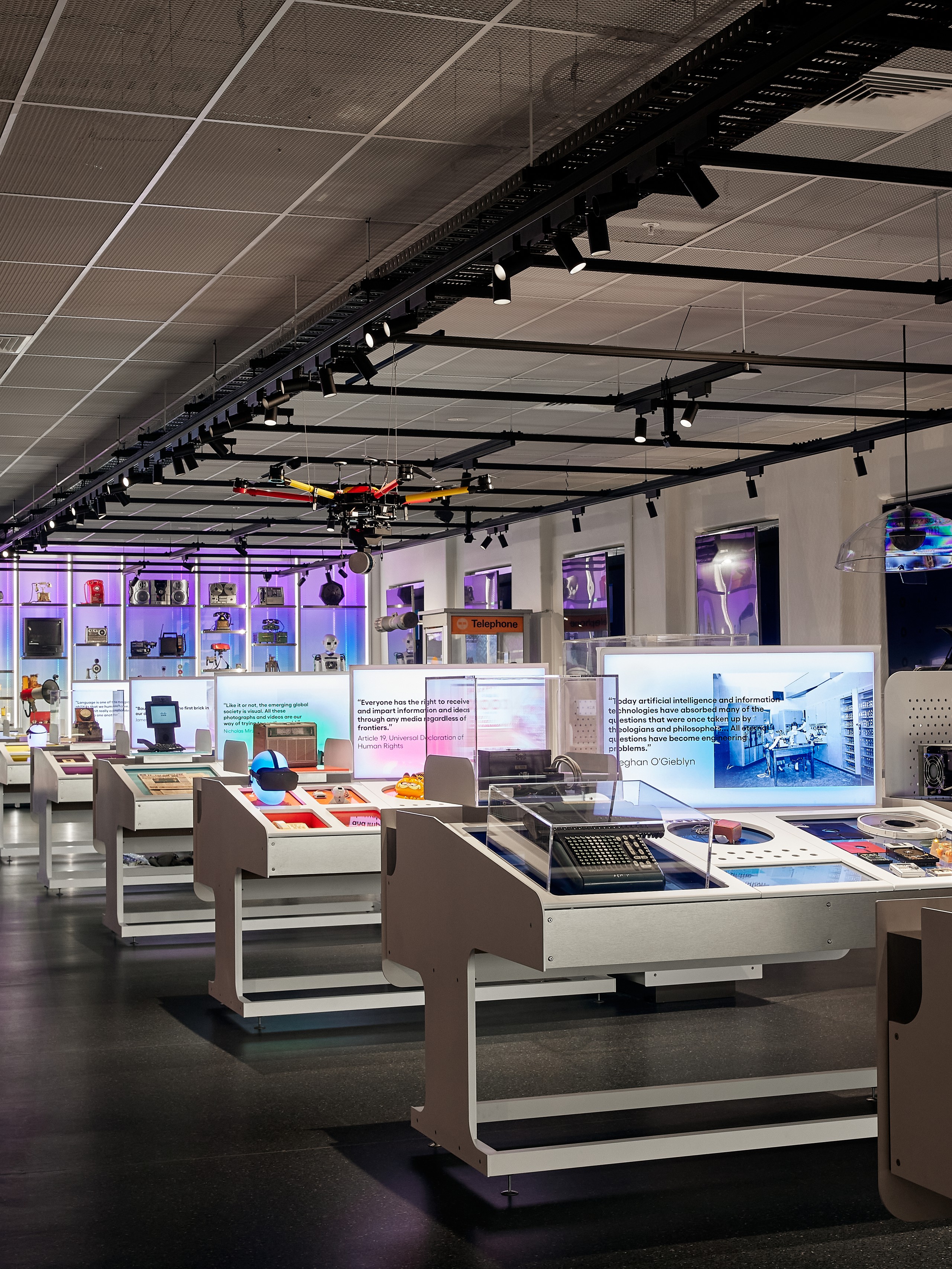
The CM-2 is one of the hero objects going on display as part of NCM's newest exhibition, Radical Computing, opening 19 September 2026, marking the first time this machine has been publicly displayed in Australia.
A cube full of light
Built in the 1980s by Thinking Machines Corporation, the Connection Machine (CM) was the first commercial supercomputer with a massively parallel architecture. Something that made it unique was the way it was built – not around one powerful processor, but 65,536 simple ones, working in concert. Its design is as celebrated as its engineering: a matt black "cube-of-cubes," its translucent doors revealing thousands of status lights blinking as the processors computed. That design was led by industrial designer Tamiko Thiel, who has been assisting NCM with the CM-2's restoration and reinterpretation directly, with further guidance from the team at Germany's ZKM Center for Art and Media.

"Until NCM contacted me, I had never even known that there were Connection Machines in Australia! I am so excited that they will be uncovering and telling the story of computing in Australia for the first time," Thiel said. "And I am so touched that the Connection Machines were considered valuable enough to preserve for almost 30 years after they had likely stopped working — an unheard of time span for what many installations considered a worthless pile of scrap!"
"Until NCM contacted me, I had never even known that there were Connection Machines in Australia!” — Tamiko Thiel, Lead Industrial Designer, Thinking Machines Corporation
"The acquisition of the CM-2 and CM-5 is a landmark moment for NCM's collection," says NCM's Co-CEO and Artistic Director, Emily Siddons. "These computers reflect a foundational moment that will allow NCM to build our computing collection and reflect the seismic shift that AI has created for generations to come."

Restored, and reimagined
The CM-2 has been restored by the NCM Studio and Collections teams especially for Radical Computing, with Tamiko Thiel directly supporting the effort. But visitors won't just be looking at the machine, they'll also be able to interact with it.
"The acquisition of the CM-2 and CM-5 is a landmark moment for NCM's collection," — Dr Emily Siddons, Co-CEO and Artistic Director, NCM
Using TouchDesigner, NCM Studio has built a series of playful additions that sit alongside the CM-2's original 'Random and Pleasing’ light pattern, including one that reflects visitors' own silhouettes onto its blinking lights as they stand before it.
"I'm fairly certain nobody has ever used the CM-2 like this," said NCM Studio's Cameron Holman during install. Of the camera specifically, he added: "I haven't heard of someone connecting a camera to it before."
“This is a fitting example of how NCM approaches its collection; not by simply displaying historic technology behind glass but exploring how to expand its capacity using modern tools, all while preserving its history,” says Siddons. “It is entirely appropriate to reinterpret the CM-2 in this way within the broader context of the Radical Computing exhibition and marks the beginning of a global research project on the Connection Machines.”

Kept safe for 20 years, headed for the dump
The machines' path to NCM starts with one man's hunch. Emeritus Professor Christopher Barter, former Head of the Department of Computer Science at the University of Adelaide, and founder and chairman of the South Australian Centre for Parallel Computing, had the CM-2 and CM-5 in his custody for more than 20 years after they were switched off around 2000. They were headed for the scrap heap. He kept them instead.
"The reason I wanted to store them — there's no other reason — I thought they would be of historic value," Barter said.
That instinct paid off when Karl Von Moller arrived with trucks, cranes and forklifts to extract the machines from storage. The 1.4-tonne CM-5 needed a crane on both ends of the move, unable to be wheeled across a 20-metre stretch of unpaved ground between the storage site and the road. From there, the machines went to temporary storage in Adelaide until a permanent home could be found.
Barter has no doubts about where the CM-2 belongs now. "It is the most displayable machine," he said. "Its shape, its design, its blinky lights — even if you didn't know anything about computers and communications, you would look at that and say, 'my gosh, that's an artifact.'" This is the only CM-2 known to have been brought into Australia, arriving in the early 1990s for use at Australian National University in Canberra.
That home came about by chance. Guest curator Mel Huang Buntine, working on the Radical Computing exhibition for NCM, was in touch with Karl Von Moller about featuring some of his videos and asked, in passing, whether she could pass his contact details for the CM-2 and CM-5 on to the museum. He agreed, and not long after, NCM made contact. The machines have now been donated to NCM's permanent collection.

The story behind the machines
The CM-1 and CM-2 are considered the world's first commercial AI supercomputers, developed by Danny Hillis, who studied under Marvin Minsky — widely regarded as a founding figure of AI — at MIT. Hillis set out to build a machine dedicated to advancing AI research, using thousands of simple 1-bit processors linked by a distribution network that could apply instructions to all 65,536 processors simultaneously: a technique that became known as Massively Parallel Computing. The processors were connected via a 12-dimensional hypercube network for extremely fast connectivity, using a single-instruction, multiple-data (SIMD) structure. In Australia, CM-2 and CM-5 systems were put to work on research into AI, fluid dynamics, simulation and data mining.
Thiel, working with a design team at Thinking Machines Corporation, developed the CM's now-iconic form after conferring with physicist Richard Feynman — a design process that shaped the look of computing for years to follow.

Watch the story unfold
Karl Von Moller is also a filmmaker, and the recovery of the CM-2 and CM-5 will feature in an upcoming episode of his YouTube series, Computer History of Australia. The trailer is live now on his channel, State of Electronics — the full episode will follow later in 2027, as part of the series' chronological release covering IBM, Kit Computers, the Fairlight, Australian-made computers like the Microbee, the rise of the internet and social media, gaming, and quantum computing.
Follow State of Electronics on YouTube to be notified when the full episode goes live.
The CM-2 will be on public display as part of Radical Computing, opening 19 September 2026 and running until 21 February 2027 at NCM, 375 Burwood Rd, Hawthorn.
Explore more